Astronomers Discover First Known Retrograde Exoplanet Around a Red Dwarf
A sub-Neptune planet 73 light-years away orbits in the opposite direction of its small host star, challenging standard models of planetary system formation.
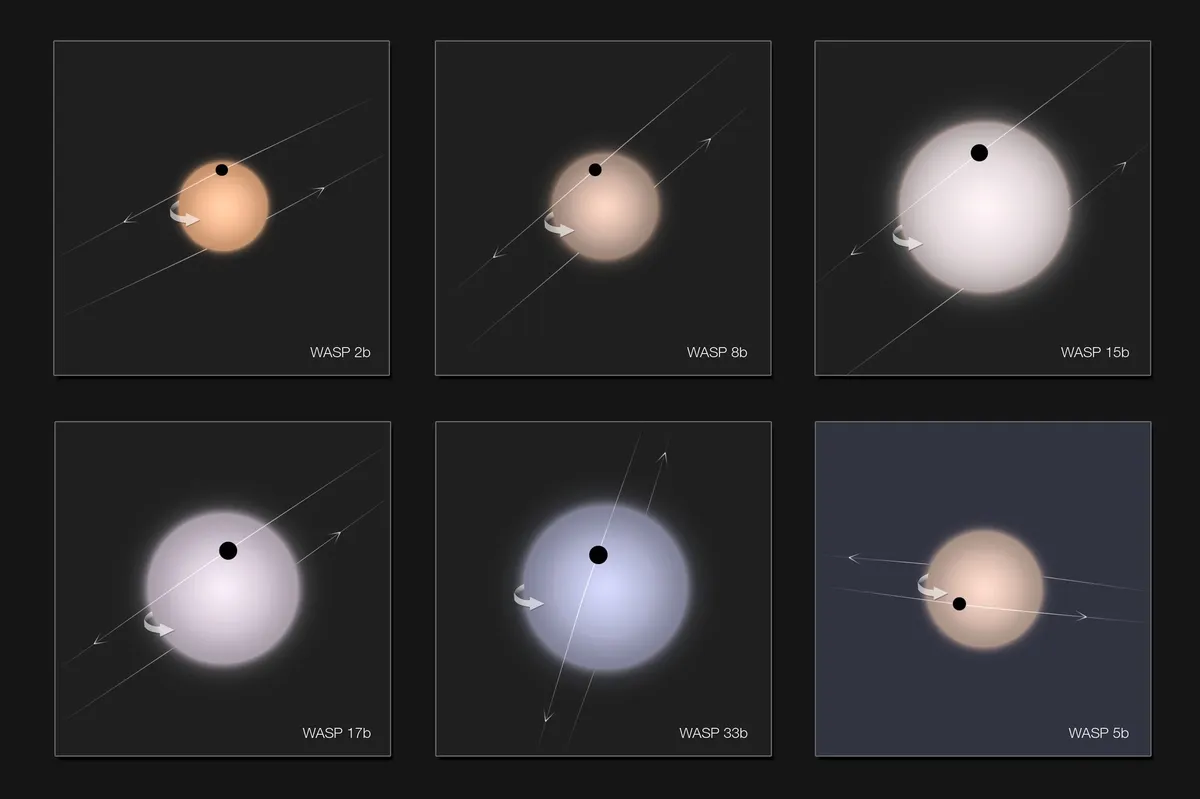
Astronomers have discovered a sub-Neptune exoplanet, GJ 3090 b, with an orbital obliquity of 136 degrees, meaning it travels in a retrograde orbit opposite to the rotation of its red dwarf star — the first known instance of such a path around a small star. This discovery challenges ideas about how planets form because conventional theory expects planetary orbits to align closely with the spin axis of their parent star, especially for compact systems around cooler stars like red dwarfs.
GJ 3090 b is located approximately 73 light-years from Earth and represents an extreme case of orbital misalignment. The University of Geneva team that made the discovery noted the planet’s orbit is not just slightly tilted but fully reversed, with an obliquity measured at 136 degrees, which classifies it as a true retrograde motion relative to the star’s spin. According to their findings, this is a ‘rebellious’ orbit that defies standard expectations for planetary systems around such stars.
The conventional explanation for such extreme misalignments in other star systems has often involved the gravitational influence of a massive companion, like another star or a giant planet, that can gradually torque a planet’s orbit over time. However, observations show GJ 3090 b lacks the massive companion that would normally be invoked to explain this kind of retrograde motion. The absence of a clear perturbing body leaves astronomers with a puzzle: how did this planet end up on such a backwards trajectory?
Red dwarf stars, also known as M-dwarfs, are the most common type of star in our galaxy and are generally cooler, smaller, and less massive than stars like our Sun. Their planetary systems are thought to form from a protoplanetary disk that should naturally align with the star’s rotation. The discovery of GJ 3090 b’s orbit suggests that either our understanding of disk dynamics around these stars is incomplete, or that some other, rarer process—such as a chaotic early migration or a past close encounter with another body since ejected from the system—can produce these wildly misaligned orbits.
The finding, reported by the University of Geneva, indicates that GJ 3090 b is the first known planet orbiting a small, cool star on a retrograde orbit. This moves the phenomenon of retrograde orbits from being a curiosity primarily observed around hotter, more massive stars into the realm of the most common stellar hosts in the Milky Way. It implies that ‘backwards’ worlds may not be as rare as previously assumed, potentially forcing a revision of planet formation and evolution models for the vast population of red dwarf systems.
For now, the case of GJ 3090 b stands as a clear exception that challenges the rule. Its existence suggests that the processes that sculpt planetary orbits, even around the quietest stars, can be more violent and less orderly than standard theory predicts. As astronomers search for more examples, this lone, backwards-orbiting sub-Neptune will likely become a benchmark for testing new theories of dynamical evolution in compact planetary systems.
Sources
- A ‘rebellious’ exoplanet orbits in the opposite direction of its star — University of Geneva
- First ‘backwards’ planet discovered around a small star challenges ideas about how planets form — Queen Mary University of London
- Scientists find weird exoplanet that orbits its star in the wrong direction — Space.com