First Plausible Exomoon Found Orbiting Brown Dwarf in CD-35 2722 System
ESO's Very Large Telescope has detected a Jupiter-mass object orbiting a brown dwarf in the CD-35 2722 system — the first plausible exomoon candidate found outside our Solar System, and a challenge to how we define moons versus planets.
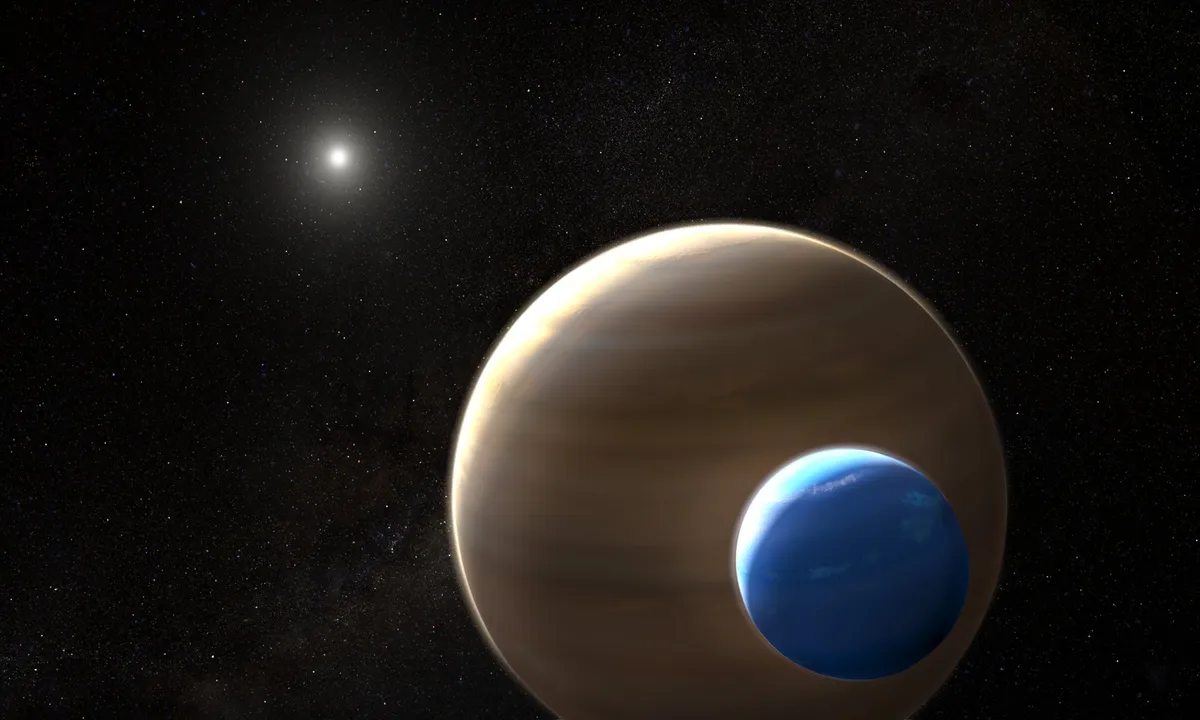
.jpg)
For decades, the search for worlds beyond our Solar System has followed a familiar pattern: find the star, then find the planets orbiting it. What sits in orbit around those planets — moons — has remained almost entirely out of reach. A new detection by the European Southern Observatory’s Very Large Telescope has just changed that, and in doing so has forced a question about what words like “moon” and “planet” even mean when applied elsewhere in the galaxy.
The object sits in the CD-35 2722 system, a small star with about half the mass of our Sun. Using the CRIRES+ instrument on ESO’s Very Large Telescope, an international team led by Kevin Hoy and Alice Zurlo from Chile has revealed evidence for a moon-like object orbiting not the star directly, but a brown dwarf that itself orbits the star. This makes it the first plausible detection of an exosatellite — an object orbiting something other than a star — despite more than 6,000 exoplanets having been catalogued to date.
The orbital arrangement is what breaks the usual vocabulary. In our Solar System, moons orbit planets, which orbit the Sun. Here, the newly found object orbits a brown dwarf, a kind of substellar object too massive to be a planet but not massive enough to sustain hydrogen fusion. Observations with the VLT and the radial velocity method revealed that this exosatellite is at least as massive as Jupiter, while the brown dwarf it circles has more than 30 times Jupiter’s mass. The study was published in Nature on July 22, 2026.
Mass and formation history both matter here. A Jupiter-mass object orbiting a star would routinely be classified as a planet. The same object orbiting a brown dwarf — which itself orbits a star — sits in a definitional gap that the International Astronomical Union has not formally closed. Whether it formed like a moon, from debris around its host, or like a binary companion, from the same collapsing cloud, is still unknown. Either way, the detection is significant: it proves that large companions can exist around substellar objects, and that our instruments have finally reached the sensitivity to find them.
The CRIRES+ instrument made this possible through precise radial velocity measurements — detecting the wobble that the orbiting exosatellite imparts on its brown dwarf host. This is the same fundamental method that has found most known exoplanets, now pushed to a regime where the signal comes not from a star-planet pair but from a much fainter brown dwarf and its companion. Technical capability and scientific category have arrived together: we can now detect objects that our existing terminology, built from a single star system, was never designed to accommodate.