James Webb Telescope Reveals Hidden Giant Planet in Beta Pictoris System
NASA's James Webb Space Telescope uncovered a previously unseen gas giant orbiting one of astronomy's most studied star systems, using spectral analysis to peer through cosmic dust and reveal the planet's atmospheric composition.
.jpg)
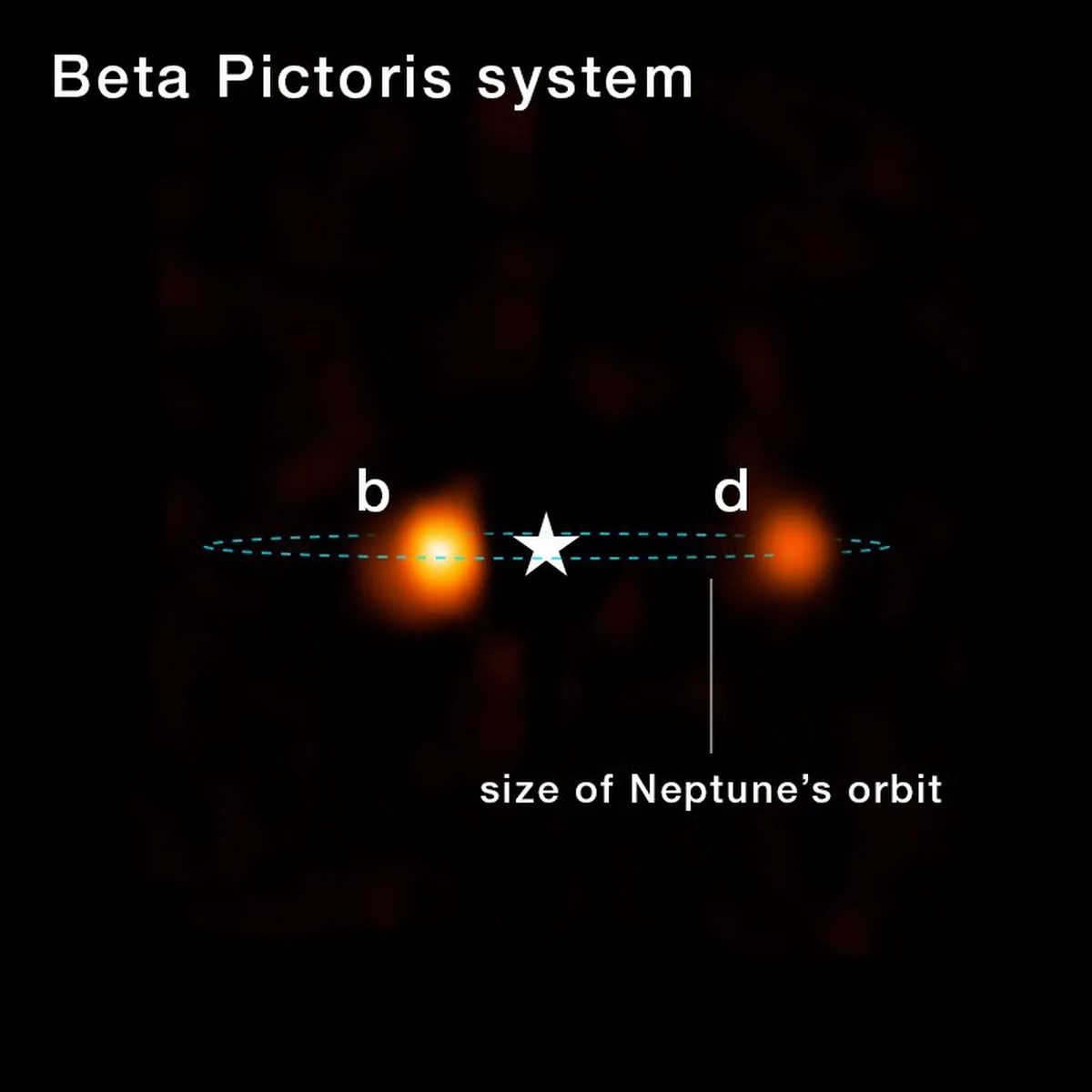
For decades, astronomers have scrutinized Beta Pictoris—a young star surrounded by a prominent debris disk—hoping to map its planetary family. Now, NASA’s James Webb Space Telescope has delivered an unexpected addition: a giant exoplanet dubbed Beta Pictoris d (β Pic d), hiding in plain sight within this iconic system.
The discovery emerged from serendipitous observations using Webb’s NIRSpec instrument, which detected atmospheric signatures of carbon monoxide, water vapor, and methane in the planet’s gaseous envelope. These chemical fingerprints were identified through spectroscopic analysis—a technique that breaks down light into its component wavelengths to decode the composition of distant worlds.
What made β Pic d elusive for so long? Its orbit lies nestled within Beta Pictoris’s glare-crowded debris disk, a thick veil of cosmic dust and asteroid fragments that obscured direct imaging. Previous attempts relied on gravitational effects, but the faint signal from such a young, distant planet proved too subtle for older telescopes to pinpoint.
The find holds profound implications for planetary formation theories. β Pic d joins two other known planets in the system, making it only the second confirmed multi-planet system where at least three worlds have been directly imaged. Its presence also suggests that planetary systems may harbor hidden companions, camouflaged by their own environmental conditions.
The detection method itself marks a leap forward. A team of astronomers used spectral template matching—comparing observed light patterns against simulated models of planetary atmospheres—to confirm the planet’s existence. This approach, applied here for the first time with moderate-resolution spectroscopy, opens new pathways to studying exoplanet interiors without needing direct imaging.
Beta Pictoris has long been a poster child for planetary system studies, its debris disk offering clues about future solar systems and young worlds in formation. Adding β Pic d deepens our understanding of how planets migrate and evolve in dynamically complex environments—while reminding us that even the most well-known cosmic neighborhoods can still surprise us.
The findings underscore Webb’s transformative power to peer through cosmic obscurants, turning seemingly impossible observations into routine science. As more such discoveries pile up, the telescope isn’t just finding planets—it’s rewriting our understanding of planetary systems one hidden world at a time.
Sources
- NASA’s Webb Discovers Hidden Planet in Famous Star System — NASA Science
- NASA’s Webb Discovers Hidden Planet in Famous Star System — Space Telescope Science Institute
- NASA’s Webb telescope discovers giant planet hiding in one of astronomy’s most famous systems — ScienceDaily
- James Webb Telescope Discovers Hidden Giant Planet in Famous Star System — SciTechDaily
- Discovery of an Exterior Third Planet Orbiting β Pictoris — arXiv