The Milky Way's Disc Was Flipped Upside Down 10 Billion Years Ago
Supercomputer simulations presented at NAM 2026 show the Milky Way's disc was flipped by more than 90 degrees after a head-on collision with the Gaia-Sausage-Enceladus dwarf galaxy roughly 10 billion years ago — a finding diagnostic tests on thousands of simulated galaxies now support.
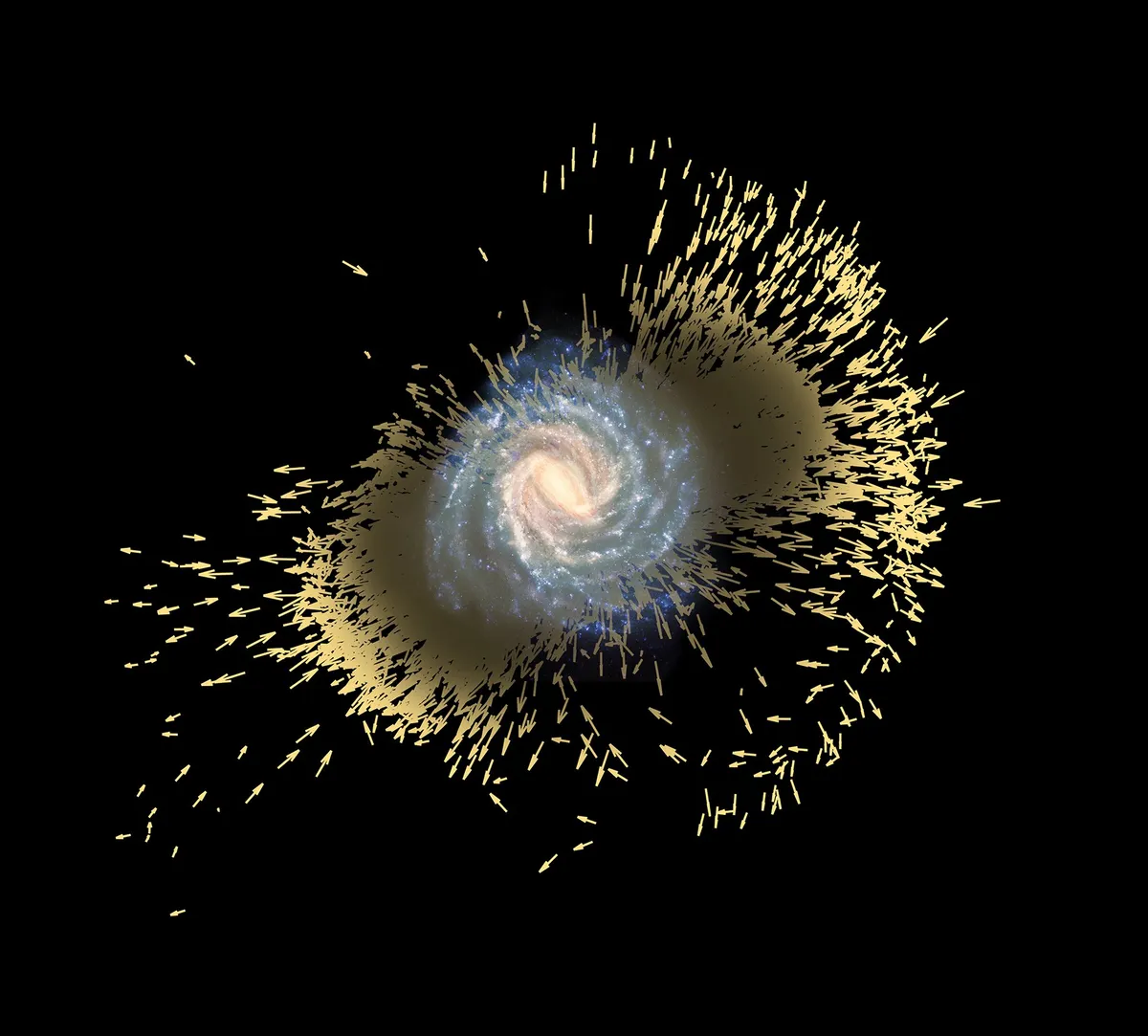

The Milky Way’s disc – the flattened plane where most of its visible stars sit and where our Sun has been orbiting for about 4.6 billion years – was once reoriented by more than 90 degrees after a violent head-on collision. According to supercomputer simulations presented at the Royal Astronomical Society’s National Astronomy Meeting in Birmingham, the culprit was a massive dwarf galaxy known as the Gaia-Sausage-Enceladus, and the event happened roughly 10 billion years ago.
The findings come from Durham University astronomer Kirill Batrakov, who used the Auriga suite of simulations modelling 25 Milky Way-like galaxies. The key finding is that galaxies whose stellar haloes rotate slowly are far more likely to have experienced a major disc flip of more than 90 degrees — and that those slow-rotating haloes correlate with a head-on merger rather than a gentler, more gradual accretion of smaller satellites.
Our own galaxy fits the pattern. The Milky Way’s stellar halo rotates at about 25 km/s, which is roughly an order of magnitude slower than the 220 km/s at which disc stars orbit. That mismatch has been known for years, but Batrakov’s team argues it is not just an incidental property — it is a direct consequence of the kind of merger that also produces a disc flip. A head-on collision with the Gaia-Sausage-Enceladus galaxy 10 to 11 billion years ago would have disrupted the Milky Way’s disc and then, as the system settled back into equilibrium, reoriented it by more than 90 degrees relative to its original plane.
The Auriga simulations work by running full cosmological models of galaxy formation — including the accretion of dark matter haloes, gas dynamics, star formation, and the tidal effects of mergers — on supercomputer hardware capable of resolving individual galaxies in enough detail to track how their discs move and deform over billions of years. By comparing the 25 simulated galaxies against each other, Batrakov’s team was able to isolate the specific condition most predictive of a flip: a slow-rotating stellar halo, which tracks reliably with a past head-on collision rather than with a series of smaller impacts.
This is not the first time the Gaia-Sausage-Enceladus event has been identified as one of the most consequential moments in the Milky Way’s history. The remnant of the dwarf galaxy is still visible as a distinctive population of stars on extreme elliptical orbits through the inner halo, and it has long been considered the most likely explanation for the thickening and chemical composition of the galactic disc. What Batrakov’s work adds is a structural test for the flip itself: a diagnostic tool that other astronomers can now apply to galaxies beyond our own. If a galaxy’s stellar halo rotates slowly, there is a strong probability that its disc was once flipped by a major merger — a prediction that was confirmed by the simulations showing a consistent link between the two properties.
The timescale matters here. At 10 billion years ago, the disc flip predates the formation of the Sun, the Earth, and essentially all of the solar system’s present-day structure by more than five billion years. The galaxy we inhabit today — spiral arms, thin disc, solar neighbourhood and all — is what settled into place after one of the most violent events in its history had already reoriented it from scratch. That the structure feels so stable now is not evidence of inviolability; it is evidence of how thoroughly the system reconstituted itself after the blow.