Webb traces the farthest fast radio burst to a metal-poor infant galaxy
FRB 20240304B, the most distant fast radio burst ever detected, was identified by the James Webb Space Telescope as originating in a young, low-metallicity galaxy 3 billion years after the Big Bang — more than double the previous distance record.
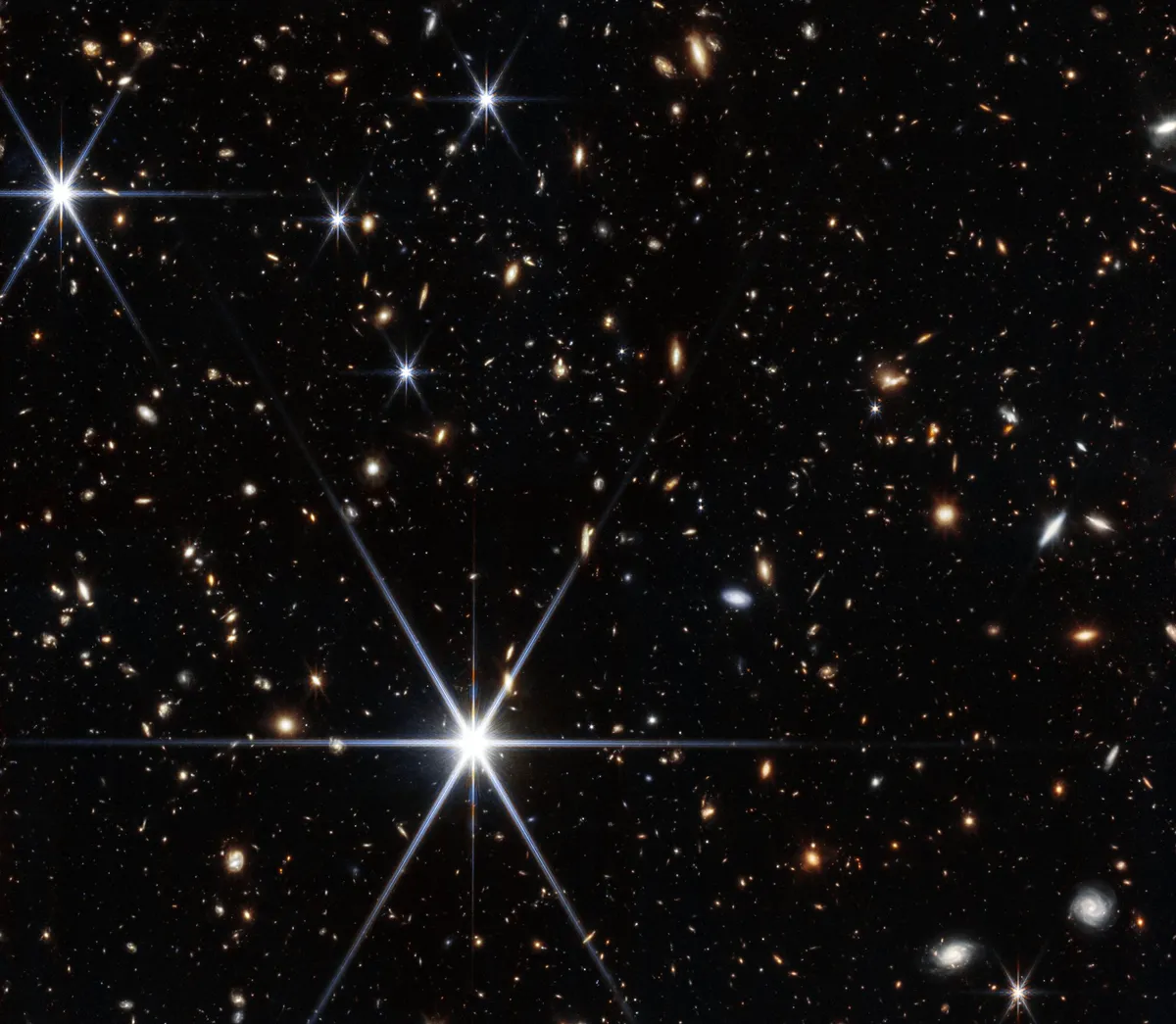

A single burst of radio energy that left its source roughly three billion years after the Big Bang — passing through about eighty percent of cosmic history before reaching an antenna in the Karoo — has set the distance record for a fast radio burst by a factor of more than two over the previous most distant example, a result announced alongside its publication in Science on 8 October 2026. The burst, designated FRB 20240304B, was picked up by the MeerKAT radio telescope array in South Africa, and the combination of its redshift and its host-galaxy properties now places it well outside the region of the universe where previous distance records for the phenomenon had been set.
The identification of the source galaxy is where the observation stops being a one-off radio detection and becomes a window into a specific epoch of galaxy formation. The James Webb Space Telescope observations pinned the host as a young, very small, actively star-forming galaxy with a notably low metallicity — in other words, a system still assembling itself from a gas pool that had only been lightly enriched by the first generations of stars. That is not the kind of environment where the bulk of the roughly nine hundred FRBs catalogued to date come from; most known hosts are mature, metal-rich disc galaxies. A low-metallicity, compact star-forming system three billion years after the Big Bang is a different setting entirely, and it narrows the plausible physical channels that can produce a coherent radio burst in that early, chemically lean environment.
The distance is the headline, but the metallicity is the constraint that makes the host interesting. In a metal-poor galaxy, the interstellar medium is less opaque in the X-ray and extreme-ulviolet bands, the initial mass function of the first star generations is still being written, and the conditions that launch a magnetar’s progenitor or that feed a hypernova are operating with a different supply table than in a spiral galaxy four times the age of the Sun. The Webb finding does not resolve which mechanism produced this particular burst, but it rules out the assumption — quietly baked into several earlier population-synthesis models — that the FRB rate scales straightforwardly with the total star-formation rate of the host independent of its chemical state.
Doubling the previous distance record also changes the population census question. If bursts this old and this faint in the radio band are detectable at all with current instrument sensitivity, the implication is that the underlying rate density in the early universe may be higher than earlier, closer-only samples suggested, or at least that the parameter space in which FRBs are generated is broader than the mature-galaxy sample had implied. The study’s own framing in Science is more measured than that — it reports the detection, the host identification, and the physical characterization — but the arithmetic of the distance increase means that any model of the cosmic FRB rate distribution now has to account for at least one confirmed member of the population sitting at eight-tenths of the lookback universe.
What the result also makes plain is the division of labour between the two instruments. MeerKAT did the thing no optical facility can do: it caught a millisecond-scale radio spike with enough flux to assign a sky position and a dispersion measure that, once cross-referenced, implied a source well beyond the local volume. Webb then did the thing no radio array can do: it resolved the faint, compact, unresolved smudge at that coordinate into a galaxy with measurable size, star-formation activity, and a spectral signature low enough in oxygen and iron to flag it as chemically young. Neither instrument’s data would have been a distance record without the other.
The paper appeared in Science on 8 October, and the Space Telescope Science Institute’s press release for the finding notes the Webb observations were made as part of the telescope’s standard science programme rather than as a dedicated campaign. That is a small logistical detail, but it underscores how much the sensitivity gap has closed: a burst this ancient, this far, this faint in the optical, was resolvable as a physical galaxy in a data set collected under ordinary observing constraints rather than a years-long, target-of-opportunity programme built specifically to hunt for it.