518-Million-Year-Old Urokodia Fossil Reveals the Earliest Known Chelicerae, the Evolutionary Precursors to Spider Fangs
X-ray tomography of a tiny Cambrian marine animal from China uncovered pincer-like limbs and book gills, tracing the origins of spider fangs and scorpion pincers back half a billion years.
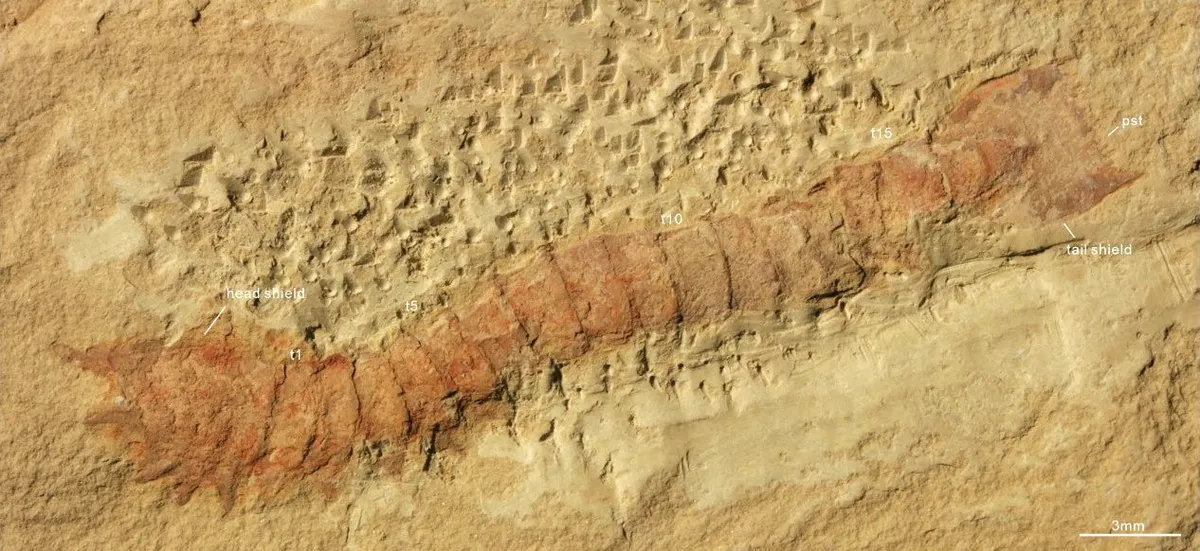

A 518-million-year-old fossil named Urokodia, recovered from China’s Chengjiang site, contains the earliest known evidence of chelicerae — the appendages that gave modern spiders their fangs and scorpions their pincers. The finding, published in Nature on August 4, 2026, pushes the origins of these iconic predatory structures back to the early Cambrian Period.
Researchers from Yunnan University and the University of Leicester used X-ray tomography to peer inside the tiny marine creature. The scans uncovered two pincer-like limbs behind the creature’s eyes that represent early chelicerae, the earliest unambiguous evidence of the appendages. The preservation also captured delicate soft tissues, including book gills structurally similar to those seen in living horseshoe crabs.
The combination of claw-like front limbs and respiratory book gills places Urokodia firmly among the earliest members of the Chelicerata, the arthropod group that today encompasses spiders, scorpions, ticks, and horseshoe crabs. In modern chelicerates, those same appendages are modified into an astonishing array of tools—venom-injecting fangs, grasping pincers, and piercing mouthparts—all tracing their evolutionary roots back to the simple two-pronged limbs preserved in this fossil.
Urokodia lived in the early Cambrian oceans, a time when most animal body plans first appear in the fossil record. Its chelicerae are the oldest known example of a feeding strategy that would later dominate terrestrial ecosystems: subduing prey with specialized front appendages. The fossil suggests that even half a billion years ago, marine ecosystems were already experimenting with the limb-to-weapon toolkit that spiders and scorpions would eventually take to land.
The discovery also reinforces the Chengjiang biota’s reputation as a window into the Cambrian explosion. While the site is famous for unusual forms like the five-eyed Opabinia, Urokodia adds a tangible link to one of the most widespread and successful animal lineages. The fact that the fossil preserves not only the hard exoskeleton but also the soft respiratory structures makes it unusually complete for an animal of its age.
The study’s authors emphasize that Urokodia does not belong to any living group of chelicerates but sits near the base of the chelicerate tree. That position makes it a crucial piece of the puzzle for understanding how the group’s defining features—the chelicerae and book gills—first assembled. And it shows that the machinery of the spider’s bite, so familiar and universally recognized, was already being built in the Cambrian seas.