Army Corps takes next step toward long-term solution for Juneau glacial flooding
The Army Corps will post a privately-bid request for proposals after this year's flood to permanently drain Suicide Basin.
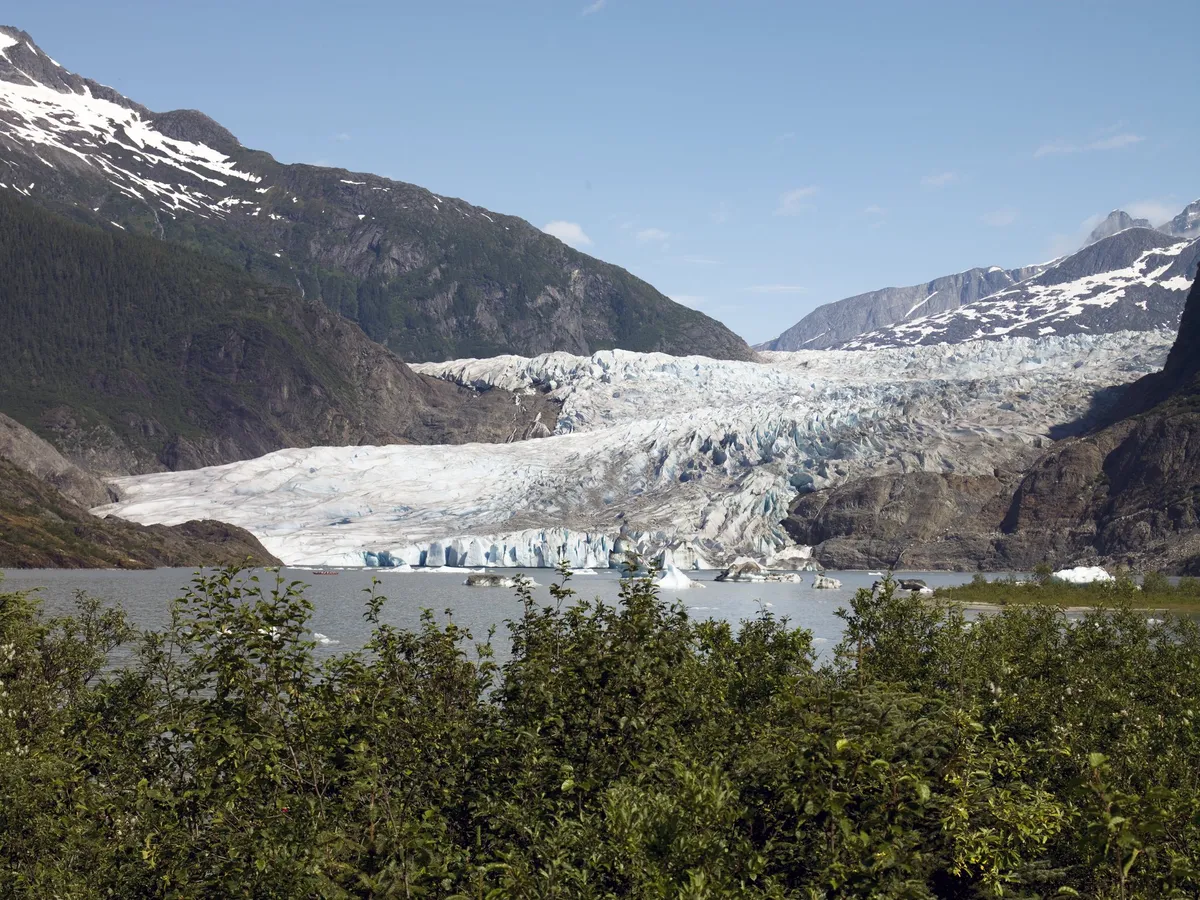
Suicide Basin, the glacial lake responsible for Juneau’s annual catastrophic flooding via glacial lake outburst flood on Mendenhall Glacier, is predicted to reach its peak level between August 8 and 10, triggering a mass of meltwater into the valley within roughly 48 hours. The basin has been filling rapidly through late July as snowmelt and ice release accelerate, pushing the outburst toward the earliest phase of Juneau’s recurrent flood season and intensifying pressure on both temporary defenses and long-term planning efforts.
HESCO barriers that just barely protected homes last summer with roughly a 50-50 chance of overtopping have been expanded and raised across the valley this year at no cost to the city, including a Phase 2 extension that pushes protection from Back Loop Bridge toward the airport. The Army Corps is also stretching its timeline for structural relief, confirming it will post a request for proposals after this year’s flood to allow permanent drainage work to begin following another round of outburst damage the Corps will wait until the basin empties in coming weeks before soliciting private-sector bids, a delay dictated by the immediate physics of Suicide Basin’s fill level rather than bureaucratic scheduling.
On August 7, Assistant Secretary Adam Telle and Senator Dan Sullivan announced that the Corps will soon issue the solicitation for private-sector bids to permanently drain the basin, abandoning plans to prescribe a single engineered answer upfront. The request for proposals is designed to be broad enough and fast enough to allow any vendor to bring innovative technology to the project, with Telle declining to commit to a specific method like tunneling or pumping until the market responds to the agency’s technical parameters. Sensitivity to Juneau’s recurring emergency cycles shaped the posture of the announcement: officials stressed that the procurement strategy must deliver results quickly, not just accurately.
The acceleration is enabled by a provision in the Water Resources and Development Act that lets the Corps bypass portions of typical planning requirements, collapsing what Sullivan characterized as a decade-long process into a timeline of just a few years. Cost estimates for a traditional tunnel solution—a “lake tap” drilled through the glacier outfall site—hovered between $613 million and $1 billion initially from the Corps, with projections extending over six years of construction. Those figures have already influenced vendor calculus; a local mining executive previously proposed an alternative approach that could cut costs roughly in half, a claim now carrying more weight as the agency moves toward competitive contracting.
With barrier defenses operating near their limits and the flood crest imminent, the Corps’ bidirectional strategy addresses both the physics of this year’s threat and the economics of the permanent fix. The immediate priority remains holding back Suicide Basin until it drains naturally in late August, but the post-flood procurement is positioned to introduce market competition into a problem the agency has long approached through internal engineering estimates. Sullivan noted the Corps would consider public-private partnerships as part of this framework, suggesting that private innovation could finally close the gap between Juneau’s urgent timeline and the cost structure of large-scale glacial flood mitigation.