Ken Shirriff reverse-engineers and powers up a 1948 IBM 604 vacuum tube flip-flop module
Ken Shirriff reverse-engineered the TR-3 trigger module from the 1948 IBM 604 Electronic Calculator and successfully demonstrated the flip-flop circuit toggling between states with glowing neon indicators.
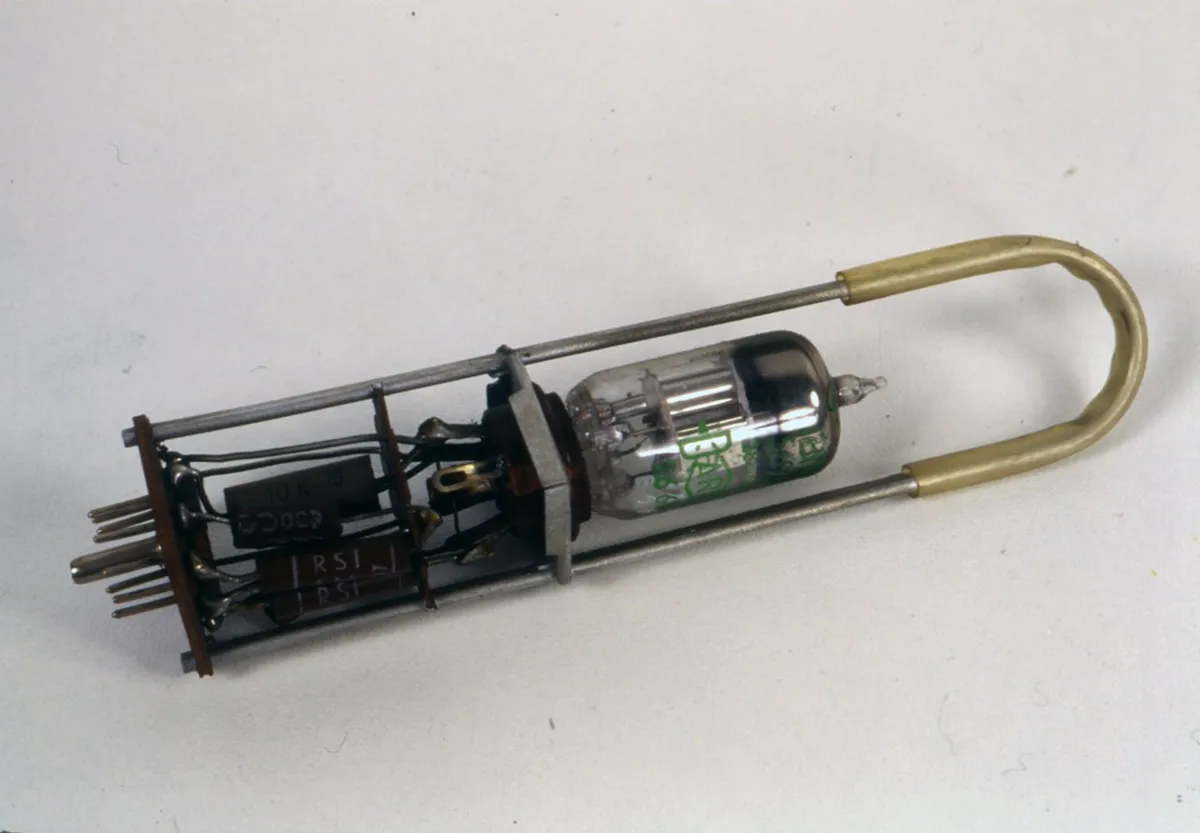

Ken Shirriff has reverse-engineered and successfully powered up a TR-3 trigger module from the IBM 604, a 1948 electronic calculator that represented IBM’s first mass-produced computer. The module, which uses a 2033 dual triode vacuum tube to implement a flip-flop circuit capable of storing one bit of information, had sat dormant for decades before Shirriff traced its wiring and created a working schematic that allowed him to demonstrate the circuit in operation.
The IBM 604 was a programmable punch-card calculator that bridged the gap between mechanical tabulating machines and true stored-program computers. Its logic relied on vacuum tube circuits like the TR-3 module, which functioned as a basic memory element: two stable states that could represent a binary 0 or 1, with the ability to toggle between them on command. Shirriff’s reconstruction required careful reverse-engineering of the original module’s point-to-point wiring, which IBM had built using a distinctive assembly technique with components mounted on a ceramic base.
What makes the demonstration visually striking is how Shirriff made the flip-flop’s state visible. The circuit drives two orange neon bulbs that glow to indicate which state the trigger currently occupies — one bulb lit for 0, the other for 1, with the toggle between them controlled by simple push buttons. The neon glow itself is electrically functional: the bulbs serve as visual indicators but also participate in the voltage-divider network that stabilizes each state.
The 2033 dual triode at the heart of the module is a type developed specifically for computer applications, with both triodes housed in a single envelope to reduce size and improve matching between the two halves of the flip-flop. This was 1948, when “computer” still meant a person who calculated for a living, and machines like the 604 were just beginning to automate that work at scale. Each bit of memory required its own vacuum tube, its own handful of passive components, its own warm-up time and failure mode.
Shirriff’s reconstruction matters partly as preservation — the original 604 is rare, and its modules are fragile — but more as a way to make visible what was always present but usually hidden. A flip-flop in a modern processor switches billions of times per second with no external sign of its activity. The TR-3 module performs the same fundamental operation, but slowly enough to watch, with light that confirms which state holds the bit. The orange glow is incidental to the computation, but it makes the abstraction concrete: here is a memory, here is it changing, here is the physical fact of information held in voltage and gas and glass.