Swiss Glaciers Lost Another 5.5% in 2026, Five-Year Total Nears 20%
Switzerland's glaciers lost 5.5% of their volume in 2026, bringing the five-year total to nearly 20%. A winter with almost no snow, followed by 76 days of summer heatwaves that pushed the freezing point above 4,000 m, drove what scientists call a 'complete explosion of melt rates.'
.jpg)
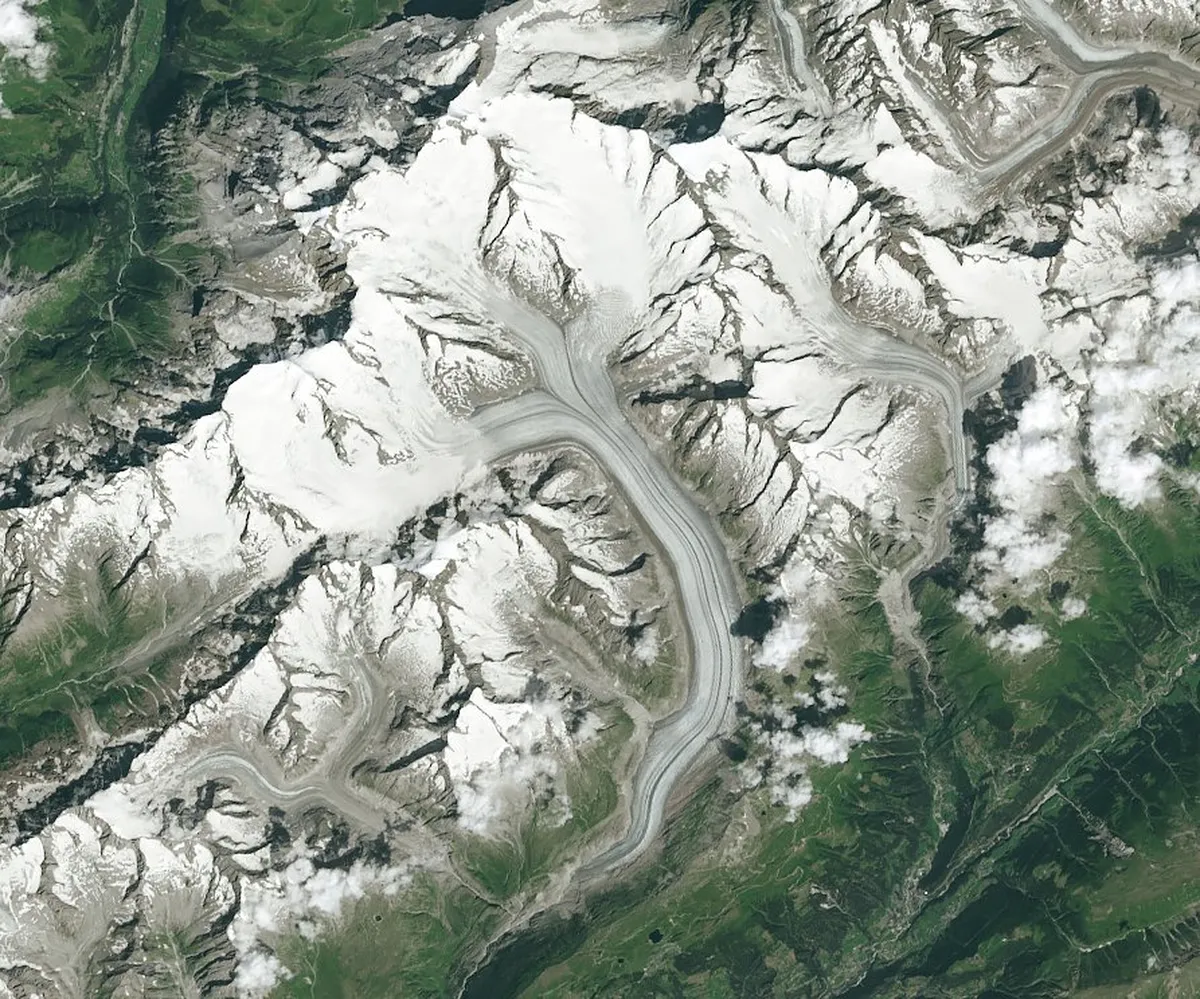
The Swiss Glacier Monitoring Network (GLAMOS) and the Swiss Commission for Cryosphere Observation published their annual report on October 1, 2026, documenting what glaciologist Matthias Huss calls a “complete explosion of melt rates” with glaciers collapsing from internal streams. The nation’s ice lost 5.5% of its volume in the first eight months of 2026 alone, bringing the cumulative loss since 2021 to 19.4%. The catastrophe was driven by a winter with exceptionally little snow followed by record-breaking summer heatwaves that pushed the freezing point above 4,000 m for 76 days.
The scale of water released is staggering: between July and September 2026, the disappearing Swiss glaciers discharged an estimated 2.2 trillion litres of meltwater, a volume roughly equivalent to the annual drinking water consumption of every person in Switzerland several times over. Several smaller glaciers have already vanished entirely — including Bella Tola and Griessfirn, which no longer exist as flowing ice bodies — while scientists describe the melt as an “explosion” that has accelerated far beyond the gradual retreat observed in previous decades.
The ETH Zurich report confirmed that the summer of 2026 saw 76 days of heatwave conditions, with the freezing level repeatedly exceeding 4,000 metres — a threshold that used to be reached only a few days per year, if at all. That sustained warmth, combined with the nearly absent winter snowpack that normally insulates ice from direct solar radiation, caused glaciers to thin rapidly across all elevations. The loss is not just surface melting: internal drainage channels have widened and fragmented the ice, leading to structural collapses that accelerate disintegration from the inside.
For Switzerland, a country whose alpine identity has long been wrapped up in its glaciers, the five-year figure — nearly one-fifth of the total ice volume erased since 2021 — represents a staggering acceleration of a trend that scientists have warned about for decades. The 5.5% loss in 2026 alone exceeds the average annual loss of roughly 2% in the 2010s, and the monitoring network’s continuous measurements show no sign of a slowdown.
The drivers are unambiguous: the combination of a poor snow year and extreme summer heat creates a feedback loop in which darker, debris-covered ice absorbs more solar energy, leading to further melting. While the broader context of global fossil-fuel pollution underpins the long-term warming, the immediate cause of this year’s record is the specific alignment of low winter accumulation and summer temperatures that broke historical highs. As Huss noted, the glaciers are not just retreating — they are collapsing from within, a sign that the remaining ice has become structurally unstable. The report leaves little room for hope that the trend can be reversed under current climate conditions.