The First ALMA SETI Survey Looked Where Nobody Had Listened, and Found a Bigger Search Than Anyone Knew
A new survey using the ALMA telescope searched for alien signals in radio frequencies above the traditional 'water hole' range and found nothing, but its results show past surveys may have covered over 6 million stars, not the 288,000 previously estimated.
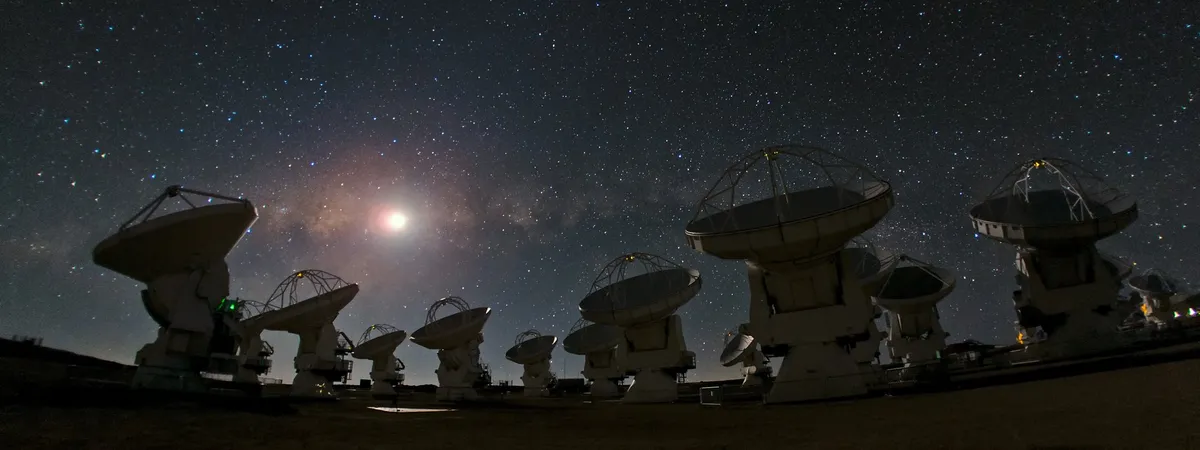

For decades, the Search for extraterrestrial intelligence has concentrated on a quiet region of the radio spectrum known as the ‘water hole,’ a range between the hydrogen line and hydroxyl line frequencies thought to be a natural listening post. A new survey has just looked much higher, using the Atacama Large Millimeter/submillimeter Array (ALMA) to scan the sky between 85 and 105 GHz — and while it found no signals, it also revealed that the scale of our past searches is likely much larger than anyone thought. The first-of-its-kind ALMA SETI survey explores higher radio frequencies beyond traditional ‘water hole’ range, looking for the kind of narrow-band emission a powerful transmitter would produce, but came up empty.
The survey’s null result is significant less for the lack of a detection and more for what it says about the volume of space we’ve already been listening to. The survey design allowed researchers to infer just how many stars previous, less sensitive all-sky surveys might have inadvertently covered. That analysis demonstrates that past surveys may have covered over 6 million stars, a figure that stands in stark contrast to the widely cited prior estimate of 288,000.
That difference is not a simple error in counting, but a fundamental change in how we understand the reach of our instruments. Past estimates were based on a more conservative understanding of a telescope’s beam pattern and the population of stars within it. The ALMA team’s methodology suggests the effective coverage of older, broader surveys was vastly underestimated, meaning humanity has already listened in on millions more potential stellar systems than we gave ourselves credit for.
The implications are less about finding a signal we missed and more about calibrating our expectations for what comes next. If the silent sky is the result of having already scanned six million stars, then the absence of a signal carries a different statistical weight than if we had only checked a few hundred thousand. It sharpens the question of whether we are looking in the right places, with the right sensitivity, rather than simply needing to look at more stars.
ALMA’s unique capability to observe at these higher millimeter and submillimeter wavelengths means this survey was a genuine first, a probe into a part of the spectrum that has been mostly ignored by SETI efforts focused on lower frequencies. The survey searched new higher radio frequencies for alien signals, finding none but revealing past surveys may have covered far more stars than previously estimated. Its primary finding, then, is a negative one: there are no obvious, powerful transmitters in this frequency band pointing at us from within the survey’s range.
That leaves the field with a more precise, if still silent, map of where not to look, and a dramatically revised sense of scale for where it has already looked. The next generation of SETI projects will now have to contend with the fact that the ‘great silence’ already encompasses not a city’s worth of stars, but a metropolis’s. The search continues, but the context for what a non-detection means has just been rewritten by an order of magnitude.