Astronomers confirm Elias 2-24 b as youngest known exoplanet at under one million years old
A Jupiter-size planet still gathering material from its natal disk challenges formation models with its rapid growth at 55 times Earth's orbital distance.
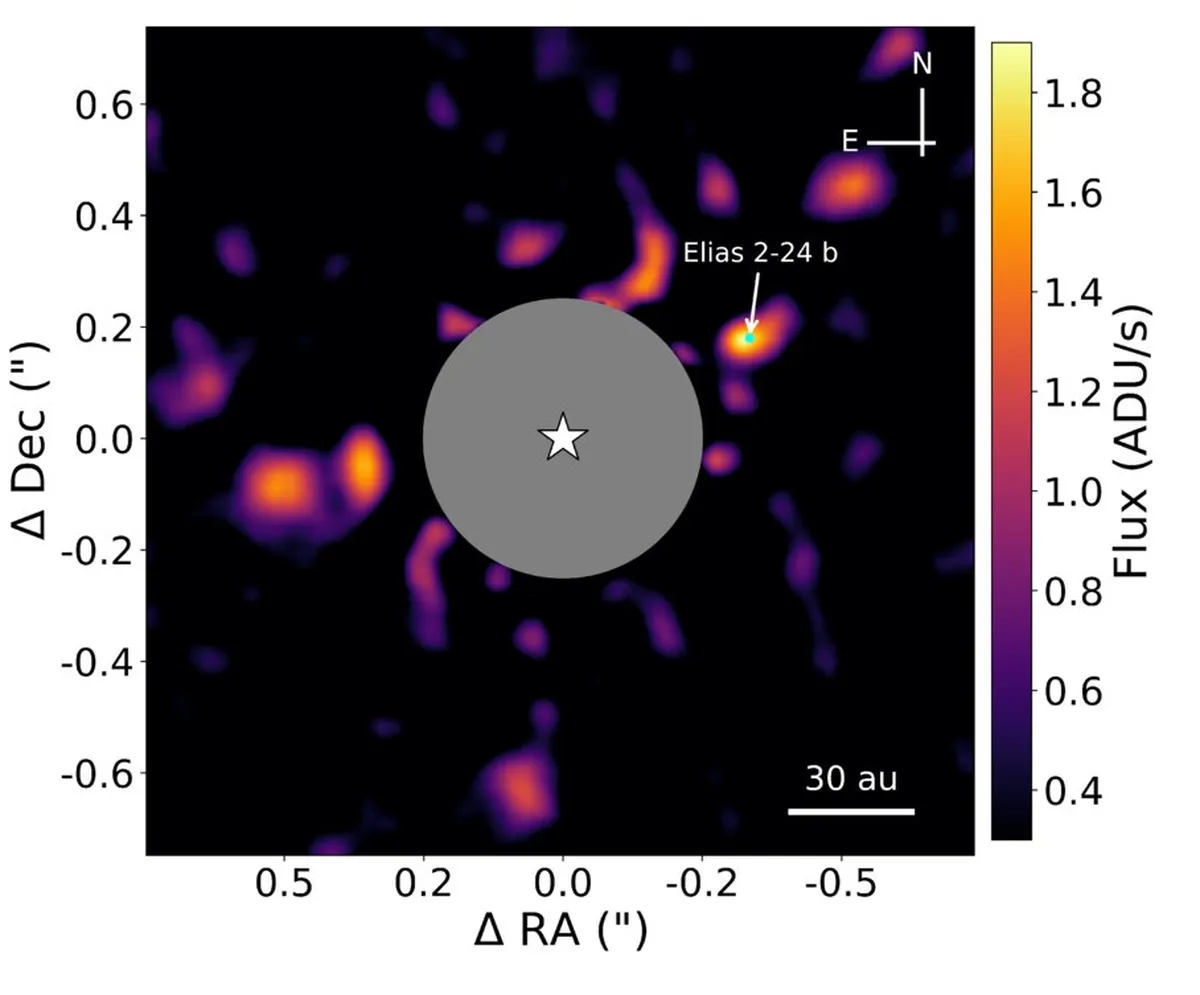

Astronomers have confirmed what appears to be the youngest exoplanet ever detected: a Jupiter-size world orbiting the young star Elias 2-24 that is less than a million years old and still actively gathering material from the disk of gas and dust surrounding its host. The discovery, led by researchers at Diego Portales University and published in The Astrophysical Journal Letters, establishes Elias 2-24 b as a benchmark for how quickly planets can form.
The planet sits at an unusual distance from its star—roughly 55 times farther than Earth is from the Sun—and was identified in archival observations from the W. M. Keck Observatory in Hawaii. That orbital separation matters because it places the planet well beyond the region where core accretion, the standard model for gas giant formation, is expected to operate efficiently. The finding was made by combining data from Keck, ALMA, and the Very Large Telescope.
What makes the age estimate compelling is that Elias 2-24 b is still whirling in its natal disk of dust and gas, the protoplanetary disk from which stars and their planets coalesce. Most confirmed exoplanets are billions of years old; the previous record holders for youngest known worlds were already over 5 million years old and had largely cleared their surrounding material. Seeing a planet this early in its assembly, still accreting mass from its environment, offers a rare window into the formation process itself.
The discovery poses a direct challenge to planet-formation models. Core accretion struggles to build gas giants quickly enough at such large orbital distances, where the protoplanetary disk is colder, less dense, and dynamical timescales are longer. Alternative mechanisms like disk instability—where a massive disk fragments directly into clumps that collapse into planets—have been proposed for wide-separation giants, but observational constraints on these models remain scarce. A planet under a million years old, actively growing at 55 AU, provides a hard data point that any successful theory must now accommodate.
The confirmation also illustrates what can be extracted from existing observational archives. The Keck data used in this study were not originally collected to find planets; reanalysis with updated techniques and cross-referenced with complementary datasets from ALMA and the VLT turned up a signal that had been sitting in the record for years. For a field where telescope time is scarce and competition is fierce, the ability to mine archival material for new discoveries represents a meaningful expansion of what can be learned without new observations.
What comes next is characterizing the planet’s atmosphere and accretion rate in more detail, and searching for additional young candidates in similar datasets. If Elias 2-24 b is not unique—if other infant planets are hiding in archival observations of young stellar systems—then the era of exoplanet discovery may be expanding to include not just the diversity of mature planetary systems, but the full timeline of how they assemble from diffuse disks into worlds.