Inouye Solar Telescope Captures First Kelvin–Helmholtz Instability on the Sun's Surface
Scientists using the NSF Daniel K. Inouye Solar Telescope have confirmed the presence of Kelvin–Helmholtz instability on the Sun's photosphere for the first time, validating a decades-old theoretical prediction and revealing a hidden channel for plasma mixing and energy transport at the solar surface.
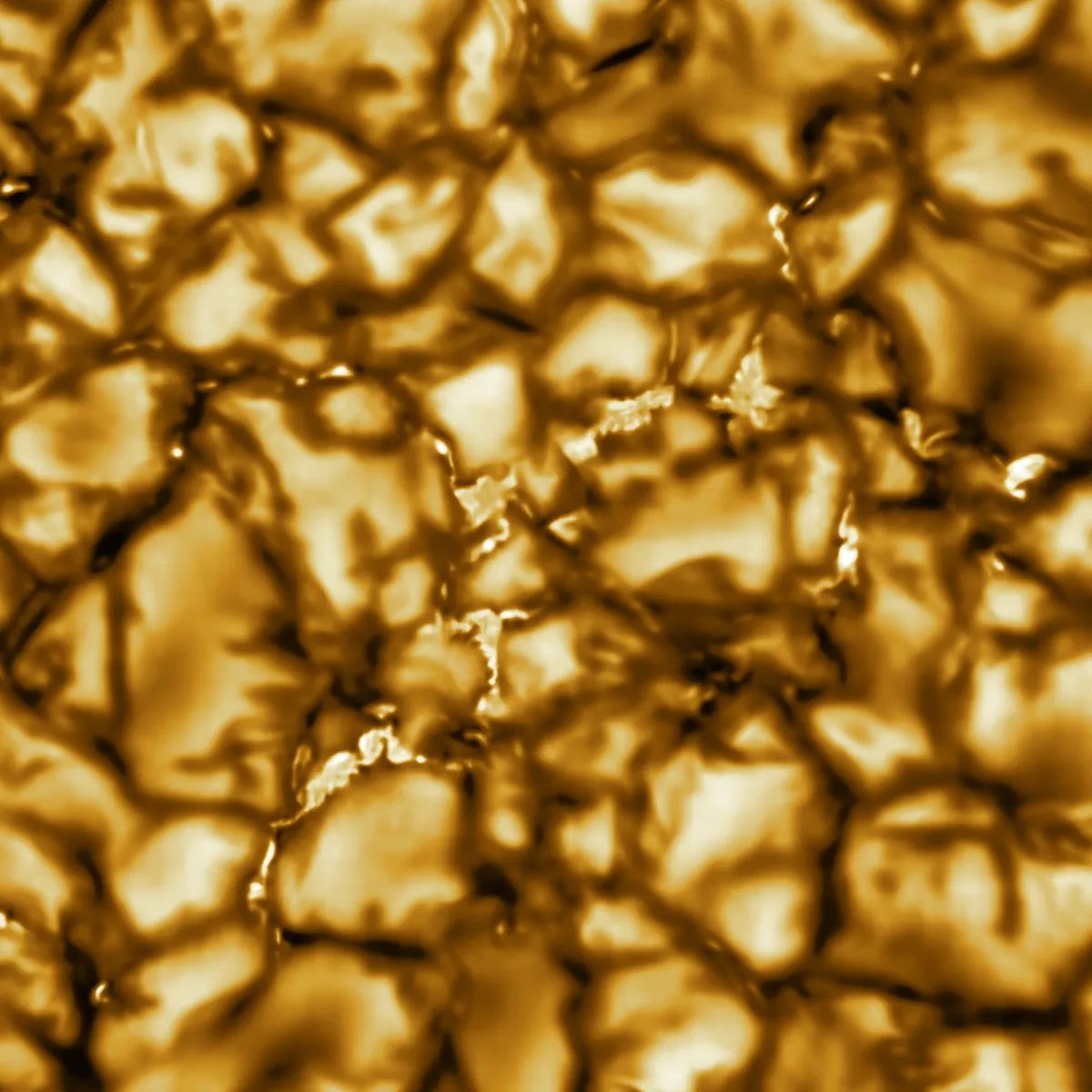
On August 5, 2026, Nature published the first direct observation of Kelvin–Helmholtz instability on the Sun’s photosphere, captured by the NSF Daniel K. Inouye Solar Telescope — confirming a long-standing theoretical prediction about how plasma behaves at the solar surface. The observation came from the highest-resolution image of the Sun’s visible surface ever recorded, and it revealed structures that had been theorized for decades but never resolved clearly enough to identify definitively.
The phenomenon itself is a fluid-dynamic process familiar from terrestrial settings — cloud formations over mountains, waves cresting and breaking at the boundary between ocean currents — but seeing it operate on the Sun required a resolution that was, until now, out of reach. Kelvin–Helmholtz instability occurs when two adjacent layers of fluid or plasma move at different velocities across a shared boundary, shearing the interface into characteristic rolled wave structures that eventually break and mix the layers together. On the Sun, the velocity differentials across the edges of concentrated magnetic flux were sufficient to trigger exactly this process.
What the Inouye Telescope resolved were those instability structures forming at the boundaries of magnetic flux concentrations on the Sun’s visible surface — the edges where tightly bundled magnetic fields meet the surrounding plasma. The resolution was fine enough to distinguish the rolled, wave-like morphology from other surface phenomena, which had been a persistent obstacle in earlier, lower-resolution datasets.
The discovery matters because it identifies a previously unobserved mechanism for plasma mixing and energy transport in the region of the Sun that drives the activity responsible for space weather. The world’s most powerful solar telescope uncovered a hidden process that contributes to solar activity, one that theorists had long expected to exist but could not confirm without the kind of resolution the Inouye instrument now provides. Understanding how energy moves across the photosphere — and how magnetic boundaries interact with surrounding plasma — feeds directly into models that predict coronal mass ejections and solar flares, both of which carry real consequences for satellites, communications infrastructure, and power grids on Earth.
The telescope itself, located at the Haleakalā Observatory in Maui, Hawaii, has been producing progressively sharper images of the solar surface since its inauguration, and this result represents one of the first major scientific payoffs from its full observational capability. The Nature paper positions the finding not as an isolated curiosity but as evidence that Kelvin–Helmholtz instability is likely ubiquitous where the conditions for it exist on the Sun, meaning the photosphere may host these structures far more often than previously assumed — they simply hadn’t been sharp enough to see before now.
Sources
- NSF Inouye Solar Telescope Enables Major Discovery of a Hidden Solar Process — NSF National Solar Observatory
- Ubiquitous Kelvin-Helmholtz instabilities driving plasma mixing on the Sun — Nature
- Highest resolution view of the sun yet reveals magnetic mysteries — CNN
- Inouye Solar Telescope Sees the Sun Closer Than Ever — Sky and Telescope