Cornell researchers demonstrate uranium ditelluride hosts two coexisting superconducting states
Experiments on UTe2 reveal it can sustain two distinct superconducting order parameters simultaneously, strengthening its candidacy as a material that could enable fault-tolerant quantum computing.
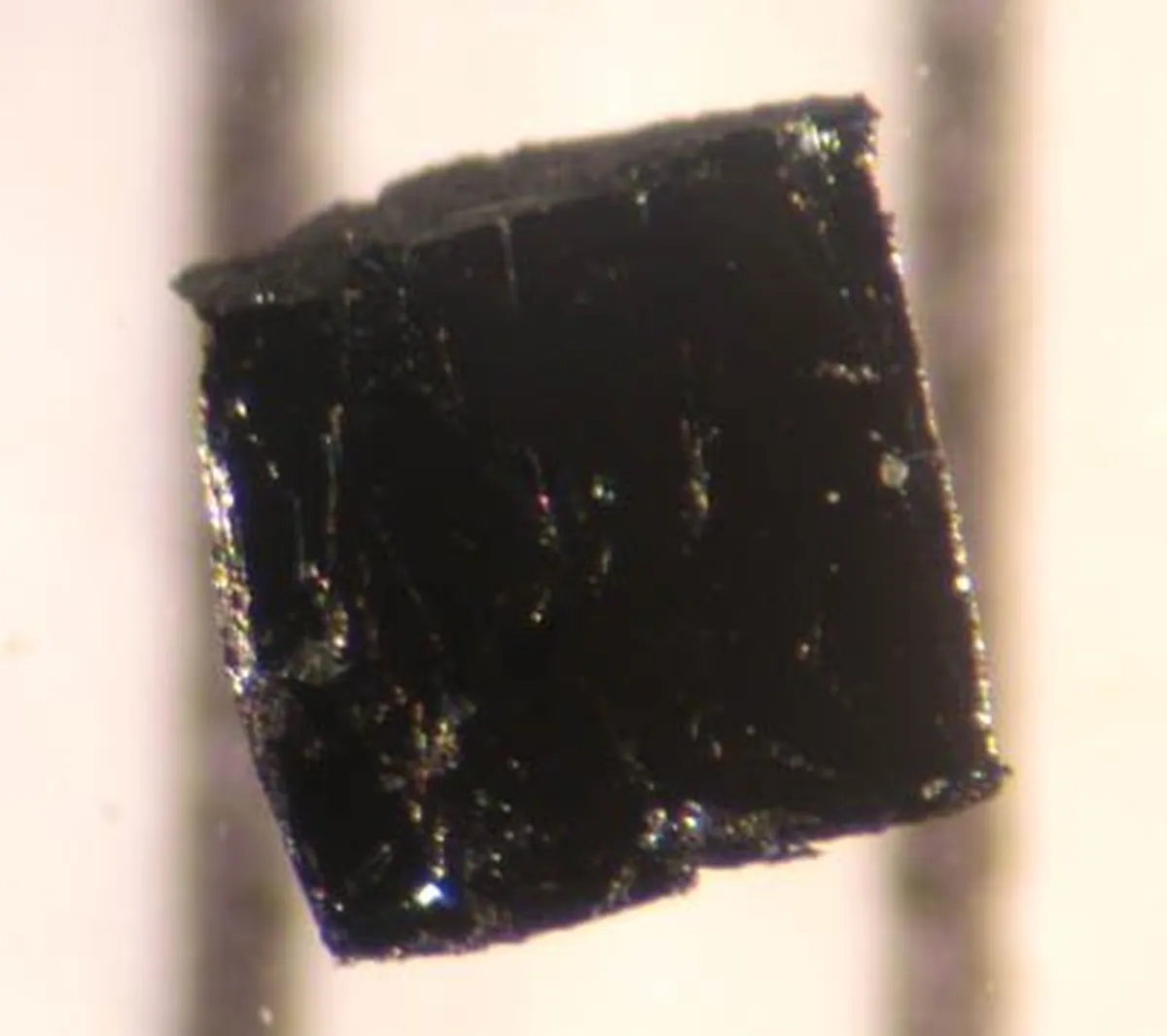

A material that might finally deliver on the promise of fault-tolerant quantum computing just passed a critical test. In work published October 30 in Nature Physics, Cornell researchers demonstrated that uranium ditelluride (UTe2) can exhibit two distinct “flavors” of superconductivity at the same time — a finding that sets it apart as the leading candidate for a topological superconductor.
The experiments mapped how UTe2 behaves under extreme cold, pressure, and magnetic fields, and what they found was unexpected. Rather than one superconducting phase giving way to another as conditions change, the material can host both simultaneously — a multicomponent state that emerges beyond a specific threshold the researchers identified as a tetracritical point. The Nature Physics paper establishes that strong competition between these two superconducting order parameters actually drives a loss of order when cooling proceeds, a subtle thermodynamic signature that confirms both states are genuinely present and interacting.
Why this matters requires stepping back to what makes topological superconductors so sought-after in the first place. In conventional superconductors, Cooper pairs of electrons form and flow without resistance, but the pairs themselves carry no useful quantum information. In a topological superconductor, the pairing symmetry and material structure conspire to create quasiparticles known as Majorana zero modes — excitations that are their own antiparticles and, crucially, encode quantum information in a way that is inherently protected from local noise and decoherence. A quantum bit built from such modes would not need the elaborate error-correction schemes that consume most of the physical qubits in today’s leading platforms.
The catch has been finding a material that actually behaves this way. UTe2 has been a promising candidate since its initial discovery, with early measurements suggesting unconventional superconductivity and possible topological character. What the Cornell work adds is experimental proof that the material’s superconductivity is not just unconventional but multicomponent — the specific ingredient theorists have identified as necessary for the topological protection to emerge. As reported by Finger Lakes 1, the coexistence of two superconducting states in UTe2 distinguishes it from other candidate materials where only a single superconducting phase has been observed.
The experimental approach itself is worth noting. The team used thermodynamic measurements — tracking how the material’s entropy and specific heat respond to magnetic fields and pressure — to map the phase diagram with precision. This is harder work than measuring electrical resistance, which drops to zero in any superconductor and gives little information about what’s happening microscopically. Thermodynamic signatures reveal the underlying order parameters directly, and in this case they showed unambiguous evidence of two coexisting superconducting components competing for dominance.
Whether UTe2 actually hosts Majorana modes, and whether those modes can be manipulated and read out in a working device, remains to be demonstrated. The history of topological quantum computing is littered with materials that looked promising until closer inspection revealed fatal flaws — fragile surface states, impurity sensitivity, or simply the wrong kind of superconducting pairing. What the Cornell result establishes is that UTe2 has passed a necessary filter: it has the right microscopic ingredients. The next steps will involve nanofabrication, junction experiments, and the slow work of building actual devices. But for a field that has been searching for a suitable material for more than a decade, knowing where to focus effort is itself genuine progress.
Sources
- Two flavors of superconductivity: Material has right ingredients for a twist — Cornell Chronicle
- Cornell experiment finds coexisting superconducting states in quantum-computing candidate — Finger Lakes 1
- Thermodynamic demonstration of tetracriticality and multicomponent superconductivity in UTe2 — Nature Physics