The 2026 Europhysics Prize Honors the Discovery of Altermagnetism as a Third Fundamental Magnetic Phase
On July 24, the European Physical Society announced three researchers receive the 2026 Europhysics Prize for discovering altermagnetism, a third fundamental class of magnetic order that combines zero net magnetization with spin-polarized electronic properties.
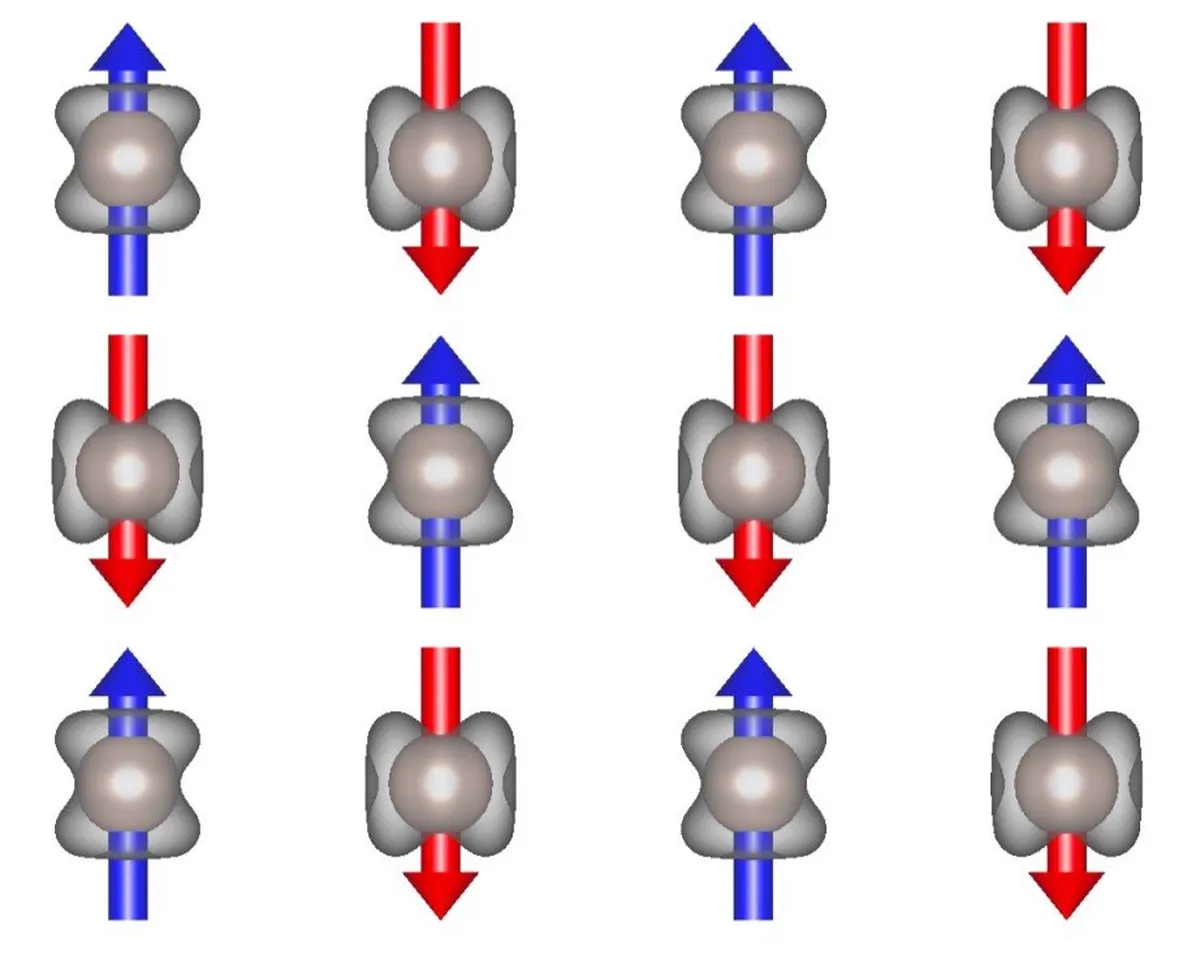
On July 24, the European Physical Society announced that Dr. Libor Šmejkal, Prof. Jairo Sinova, and Prof. Tomas Jungwirth have received the 2026 Europhysics Prize for establishing altermagnetism as a previously unknown magnetic phase combining no net magnetization with ferromagnetic-like electronic properties. The honor recognizes a decade-long collaboration that upended a long-standing dichotomy in condensed matter physics, proving that crystalline materials can host magnetic ordering beyond the traditional two classes.
Altermagnetism occupies a precise middle ground between established phases: it produces no net magnetization like an antiferromagnet while simultaneously exhibiting spin-polarized electronic properties previously thought exclusive to ferromagnets. For researchers working on next-generation spintronics and low-power data storage, the discovery means a material can route spin information without generating stray magnetic fields that interfere with neighboring components. Understanding how this phase behaves requires rethinking standard symmetry classifications, which is why experts have quickly categorized altermagnetism alongside ferromagnetism and antiferromagnetism as a foundational state of matter rather than a niche exception.
Theoretical groundwork for the phenomenon emerged from a partnership between Mainz University and the Czech Academy of Sciences, where researchers began mapping out the necessary conditions in 2016. Dr. Šmejkal spearheaded much of that initial modeling work while at Johannes Gutenberg University Mainz, developing the mathematical framework over eight years before experimental validation could even be attempted. The prize citation highlights how the theoretical prediction relied on combining symmetry theory with spintronics device physics to identify viable candidates, a path that required identifying materials where antiferromagnetic ordering could somehow preserve the spin-split band structure typically reserved for ferromagnets.
That gap between mathematical symmetry and physical realization finally closed in 2024, when independent experimental groups confirmed the predicted signatures in candidate compounds. The successful verification transformed altermagnetism from an abstract classification into a workable foundation for device engineering, validating the long timeline between initial prediction and laboratory proof. The Europhysics Prize committee noted that the award honors exactly this decade-long arc from symmetry-based prediction to experimental confirmation, treating the discovery as a complete loop rather than a partial result.
The formal recognition will take place on September 22, 2026, during the award ceremony at the EPS CMD32 conference in Graz, Austria, giving researchers an official platform to discuss how this third magnetic phase might reshape sensor design, memory architectures, and quantum material synthesis. For now, the discovery stands as a rare example of theoretical symmetry analysis successfully dictating experimental search parameters, followed by rapid verification once the right material family was isolated. A century of magnetic classification has just gained a new coordinate system, and the engineering applications are already moving ahead of the textbooks.