CMS Publishes High-Precision CP Violation Measurements Using Largest Beauty Meson Sample to Date
The CMS Collaboration has released results from the largest sample of beauty mesons ever analyzed, delivering the most precise measurement yet of CP violation in the decay of the B0s particle.
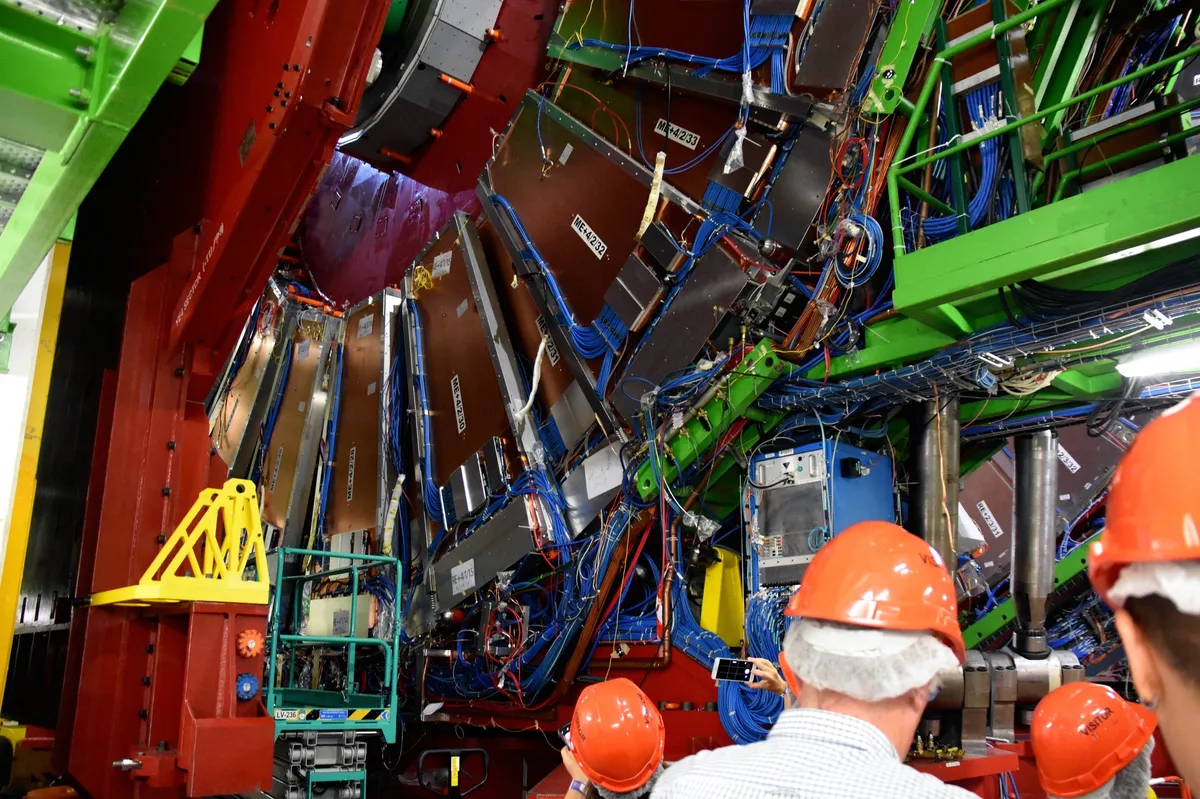

The CMS Collaboration at CERN has published results from analyzing proton-proton collision data collected between 2022 and 2025, using the largest sample of beauty mesons to date to perform high-precision tests of CP violation in matter-antimatter asymmetry. The study reconstructed specific decays of about 1.4 million B0 mesons and 16,000 B0s mesons, using AI algorithms to identify meson types at production moment. This scale of data allows for a statistical precision previously unattainable in such direct comparisons of matter and antimatter behavior.
The core of the measurement is a parameter called the CP-violating phase, which quantifies a tiny, fundamental difference in how a particle and its antimatter counterpart decay. The fact that these decays are not perfectly symmetrical is a cornerstone of the theory that explains why the universe today is made of matter, with almost no primordial antimatter left over. The new result for the B0s meson’s decay into a J/ψ meson and a neutral kaon is the most precise measurement to date of CP violation in that specific decay channel, achieving a statistical uncertainty that squeezes past previous experimental limits.
Crucially, the measured CP violation phase for both the B0 and B0s mesons aligns with the predictions of the Standard Model of particle physics. This consistency is a significant finding in itself. If the results had deviated sharply from theoretical expectations, it could have pointed toward new, undiscovered particles or forces influencing these decays—a potential crack in the Standard Model that physicists actively search for. The high precision of this measurement, made possible by the unprecedented dataset, instead reinforces the model’s predictive power in this specific domain.
The analysis relied on advanced machine learning techniques to handle the immense complexity of the collision data. AI algorithms were trained to sift through the debris of billions of proton-proton collisions, pinpointing the subtle signatures of beauty meson production amidst an overwhelming background of other particle interactions. This computational filtering was essential to isolate the clean samples of B0 and B0s decays needed for a statistically robust measurement.
While this result does not reveal new physics beyond the Standard Model, it significantly tightens the constraints on where such physics might hide. High-precision measurements like this one define the boundary lines within which any theoretical extension to the model must operate. They narrow the search space for future experiments, telling physicists where deviations are most likely to appear if they exist at all. The work represents a step forward in the meticulous, long-term project of stress-testing our fundamental understanding of the universe’s asymmetry, one ultra-rare decay at a time.